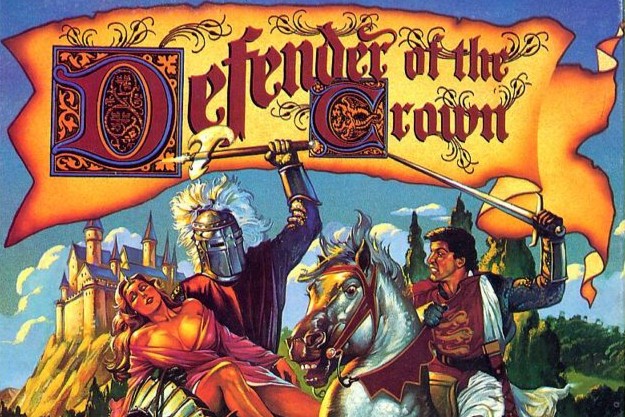

Developed/Published by: Cinemaware
Released: 11/1986
Completed: 22/01/2026
Completion: Finished it by conquering the invaders, but remained unmarried…
Defender Of The Crown is a game I’ve been eager to play, and I had a reason to boot it up a bit earlier than I intended, so I jumped at the chance. But of course, a problem immediately reared its head.
Which version to play?
The game is famous, really, as an Amiga game. If you’re not familiar with the story, video game agent Bob Jacobs saw a prototype Amiga in action, realised that the system provided a huge leap in the potential for video games, and went into business as Cinemaware1, with the explicit intention to create not merely Hollywood-inspired but Hollywood quality video games by (generally) making the graphics really fucking good. The first game to come from this was the Errol Flynn swashbuckler-inspired Defender Of the Crown.
As an “Amiga first” project, you think it would be easy to choose that version to play (after all, when I played through Pirates, I decided to play the C64 version, as it is Sid Meier’s preferred version.) But the Amiga version is not generally considered the best version to actually play because of its somewhat tortured development: originally intended to be developed by Sculptured Software, Cinemaware attempting a more “Hollywood” process than keeping everything in house, Sculptured ended up so behind on schedule–indeed, seemingly with nothing useful–that the game was handed off to a previous acquaintance, R.J. Mical, to crunch until the game was in a state it could be released.
(As usual, you can read all about this on The Digital Antiquarian. The guy’s a legend.)
Something I’ve always wondered about Cinemaware’s early releases is just how arbitrary their release dates were. It particularly stands out with Defender Of The Crown, the Amiga version of which–and I can speak from experience, now–is slight to the point of being unfinished, with apparently weeks of work from the artist, Jim Sachs, going unused. Considering the game would be improved for basically every other release, Jacobs couldn’t have let them spend a little more time on it?
That all said, no one can exactly agree which version of Defender Of The Crown to play. The Amiga version is the best looking, but the Atari ST version is somewhat close visually; versions on the Mac, PC, NES, even the humble CPC and C64 get design improvements. I was originally of a mind to play the Atari ST version, but I discovered that there’s a Defender Of The Crown II on CD32 that is, apparently, not a sequel but kind of an “ultimate” version of this era’s Defender Of The Crown, so I thought… well, I probably want to play that. And if I’m going to play that, I might as well just play the very original version so one day I can compare and contrast. After all, the whole selling point of the game originally was those graphics, so no point being short-changed there!
(As my mother would say, what a roundabout road for a shortcut.)
Now, I have played Defender Of The Crown before, briefly. My main memory of it was not quite getting the game’s mix of Risk-style strategy and simple mini-games, but thinking that when I had time I’d be able to dig into it properly, imagining it was, you know, a proper wargame.
Playing it this time round? I learned within, hmm, an hour? that while the game initially seems challenging, there’s absolutely nothing going on. No strategic depth. No “play” in the mini-games, each solvable if you can just practice them enough. If you restart the game a few times after learning the mini-games, you will essentially become unstoppable, meaning you can rinse what was once an expensive, system-selling game in an afternoon. The emperor–or I suppose, the crown defender–has no clothes on.
But dang does his body look good, am I right? As I said, it was the selling point, and playing it, you get it immediately. What you very quickly realise however is that those graphics quickly become a hindrance, because every time one of those big, gorgeous splash screens appear, you have to sit through the Amiga loading them off a floppy disk. Which is, and I always forget this for some reason, not fast. There’s a lot of waiting around so you can see a picture you’ve seen many times before (thank goodness, to be honest, that you can be done with the game so quickly.)

But that all said, what actually is the game?
Set at the time of Norman conquest (but in an extremely “made it up as we went along” anachronistic fashion) Defender Of The Crown starts with Robin Hood letting you know that the king has been assassinated, the crown lost, and the kingdom in chaos, so it’s up to you (yes, you) to sort it out.
You start by picking a Saxon hero–each of whom have different stats in leadership, jousting and swordplay, although this matters less than you’d think and the stats for one of these characters are even wrong on the selection screen–before you’re dropped onto a map of medieval England where you, two other Saxons and three invading Normans hold one castle and territory each. On each turn you have some options: to grow your army by buying soldiers, knights and catapults; to conquer territory or raid enemy castles; or to hold tournaments where you can joust for land or honour. On each turn, your opponents make the same moves (one thing I’ll say for Defender Of The Crown: it does seem to play completely fair.)
This is pretty basic, so as well as being dressed up with the graphics, it’s also dressed up with a range of mini-games. Something fascinating about Defender Of The Crown is that it’s, at least in its Amiga incarnation, completely mouse-based. This has a bit of cost in that in none of the games is the feedback that great, which is probably the reason that, for example, the jousting section is so infamous.

As befits it, it’s definitely got the most pomp and circumstance, and also seems to have the most confusion about it online. There’s a lot of discussion about when you need to hit the button to strike your opponent in a joust, or whatever, but if you just play it a bunch of times in a row you’ll eventually get it: at least on the Amiga, you don’t have to press anything at all, and the trick is knowing that you collide on the “upswing” so you just have to make sure that your lance is aimed at the center of your opponent’s shield at the peak of its bobbing movement. Once you know that you literally can’t lose, and it’s actually one of the quickest ways to win the game, because you can as of the second turn just joust the Normans to immediately take any of their land gains off of them and (probably) make a clear path to their castles all for the cost of some loading time and counting the amount of times you’ve bounced up and down on a horse (it’s seven, you hit them after seven. Spoilers, I guess.)

Once you’ve bought some catapults–each piece of land you have pays upkeep that allows you to buy units–you can attack castles, which is similarly simple to work out. You have to knock down the castle wall with a limited amount of ammo; each shot’s height is selected by “pulling” (placing your mouse) to a certain position, and it requires adjustment after each shot to make sure you’re still hitting the wall. It’s a little harder to practice this one–you have to have a castle to attack–but once you work out the first shot, you basically just have to move your mouse a few pixels up when needed and you’ve got more than enough ammo to make a few mistakes.

I wish I could be as smug about the last mini-game, but sadly, I can’t. A castle raid mini-game is triggered either by choosing to raid a castle to steal gold (don’t bother, it’s not worth it) or, occasionally, when you are notified that a comely Saxon lady has been kidnapped by the dastardly Normans and needs rescued (which, amusingly, you can turn down doing.)
This game is… awful. It’s an attempt at a side-scrolling sword-fighting game, but we’re in late 1986 so it’s not like it’s never been done before, and even being hamstrung by only being able to use the mouse is no excuse. You hold the cursor in front of your hero to move them forward, behind to move them back, and you click the mouse to attack with your rapier, with the idea being you and your companions will fight the guards until you make your way to the lady’s chamber.
I can really imagine what Jacobs pitched here: one of those amazing old swashbuckling scenes where the hero, like, swings in on a banner and then fights the enemy on a banquet table, all feints and parries. Instead what you get is this weird shuffling back and forth, hitting the mouse button constantly with absolutely no sense you’re doing… anything. As the only reward for doing this is a wife, it’s really not worth learning (am I right fellas? Take my wife, please? I wouldn’t even go and get her in the first place, etc.)
Of course, I do say that as a grown man who has seen a boob or two, but I do think if I’d been playing this contemporaneously as a kid I’d have probably gone to the effort, as the real reward is a chaste love scene between your hero and the rescued lady that I’m sure set teenage loins afire (the shadows do have some unintentional, uh, implications.)

Thankfully on my winning run I got everything sorted in England so quickly the Saxons didn’t have time to kidnap anyone (hmm, I didn’t get married in Pirates! either. I’ll need to get married in something soon otherwise people will start to talk.)
The “real” game of Defender Of The Crown is actually the Risk-style strategy game. Now I’m an absolute Risk hater–random, unfair, takes fucking forever–and Defender Of The Crown is only really preferable that you’re not going to fall out with any mates over it because you can only play it single player. The game boils down to just making your campaign army as big as possible and steamrollering opponents. Every turn, send your army home, buy more soldiers (you don’t seem to really need knights) and then smash whoever gets in your way. The game even gives you a wee bit of help in that three times you can ask Robin Hood for help (he bolsters your army a wee bit) and there’s three Norman castles, so it’s pretty obvious when to use them.

Because of the game’s design–more land means more money, more money means a bigger army–there’s really no “play” in it. If you start the game knowing what to do–grab land, win tournaments, build your army every turn, attack castles while the Norman campaign armies are in other regions–you win. It really makes this game’s smashing success seem absolutely bizarre.
But I’ll be kind to Defender Of The Crown and say that, well, most players at the time weren’t going out of their way to min-max the experience. I’m sure most players who got this played obviously losing campaigns to the bitter end; I’m sure many people never worked out jousting and found it exciting and risky. At a certain point I’m sure they found a winning, repeatable path (you really do just get the biggest army) but the game, simple as it is, will have worked until then–a generator of minor player stories as they remembered great victories and losses.
The funny thing is, it’s so uncinematic. For a company that was literally called Cinemaware, it’s strange that their games are so gamey. You would assume that a Errol Flynn-inspired swashbuckler would have started with a story, a script; a blend of cut-scenes and action scenes in order. In many ways I’d imagine the design would be more like the movie licenses released by Ocean later in the 80s and 90s–half-assed mini games with a cinematic connective tissue, and it would have probably been easier to make, less wasteful, and just as successful.
Because the hero of Defender Of The Crown is undoubtedly artist Jim Sachs. Games–even in arcades, really–in this era simply didn’t look this good, so I do understand why this was mind-blowing to anyone who brought it home for their unbelievably expensive Amiga 1000 (the 500 wouldn’t show up until 1987.)
Truly, even though I don’t think Defender Of The Crown is good (at all) Sach’s art is so beautiful and full of life that even now I think “might be nice to play Defender Of The Crown.”
That’s insane!!!
Will I ever play it again? Obviously, the thing to do is to play Defender Of The Crown II which, in a stunning plot twist, was developed entirely by Sachs!
Final Thought: Of course, now I’m thinking about how that compares to the later, more fully featured but “official” Cinemaware versions of Defender Of The Crown, which doesn’t even include the second incarnation of Cinemaware in the 2000s which put out a remaster, a PS2 version, a GBA version… like maybe I should play the Atari ST version after all, just to get the full picture??? Gnngh.
- Well, actually as “Master Designer Software” but a bit like Tales Of The Unknown, that would be almost immediately dropped. ↩︎



 Unlock with Patreon