Tag: 1983

  • The Texas Chainsaw Massacre / Halloween (Wizard Video, 1983)

    The Texas Chainsaw Massacre / Halloween (Wizard Video, 1983)

    Developed/Published by: Ed Salvo (The Texas Chainsaw Massacre), Tim Martin and Robert Barber (Halloween) / Wizard Video Games
    Released: 1983
    Completed: 22/10/2025
    Completion: I played ‘em!

    The schedule for new articles has gone a bit squiff due to life difficulties (let’s just say: if you weren’t already a subscriber, I’d be asking you to subscribe here with big wet wobbly eyes) and I had planned to do a really interesting game–the first from a very well known company, yet it doesn’t get talked about much–this week, but it’s simply taking too long to get through. So I’m going to lean on the crutch of some crappy Atari games (not least because I only mentioned The Texas Chainsaw Massacre in my Poltergeist essay) and then of course write far, far too much about them anyway.

    I’m combining them because it’s sort of hard to talk about them separately without repeating yourself relating their provenance, which relates very much to the absurdities of the pre-’83 gold rush and the resulting fallout.

    It begins with Games by Apollo, a company formed purely as cash grab by someone with no knowledge of video games–unusual at the time, but surely not the first, and absolutely not the last. That company would have its own “gang of four”-esque exodus led by Ed Salvo (who would go on to develop The Texas Chainsaw Massacre) because the company was apparently so mismanaged: The founder, Pat Roper, grew the company beyond its means to compete with Activision, and frustrated with traffic in Dallas got distracted with a plan to create two-person helicopters(???) Within a few weeks of the exodus the company collapsed.

    Somewhat desperate to get their fledgling company, Video Software Specialists (VSS) off the ground, a very strange saviour would swoop in, obviously attempting to cash-in in what was–by then–a rapidly collapsing market: Charles Band’s Wizard Video.

    If you’re familiar with Charles Band by this point, it’s probably due to his relentless, desperate exploitation of whatever IP he happens to have to hand and can make something as cheaply as possible with. Perhaps you’ve seen one of his eight (eight!) Evil Bong movies [“Don’t forget the Gingerweed Man spin-off.”–Ed.] or one of the fifteen (fifteen!) Puppet Master films? [“At least some of those are… ok?”–Ed.]

    At the time however, most of those films were but a twinkle in Band’s eye, and Wizard Video was his home video distribution company through which he was able to distribute titles such as (yes) The Texas Chainsaw Massacre. On Band’s own website he describes the decision to get into video games thus:

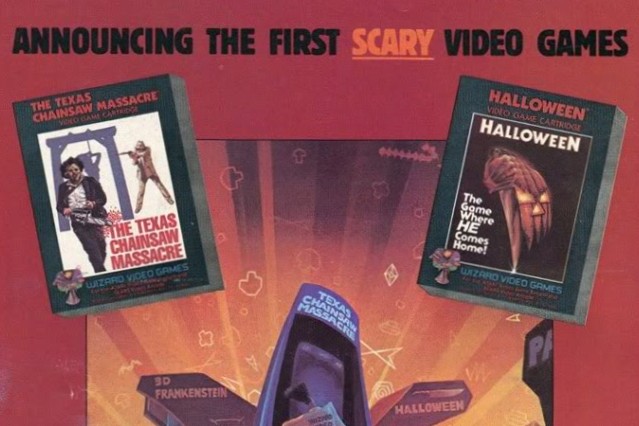
    “A forward thinking company, Wizard foresaw the potential for massive growth in home video gaming and produced adaptations of THE TEXAS CHAIN SAW MASSACRE and HALLOWEEN for the Atari 2600, which were in effect the very first horror console video games ever released.”

    I genuinely love the use of “in effect” there, because they absolutely weren’t, and they literally chose to do this while the market was crashing, which makes the portrayal even funnier.

    Either way, it seemed that Band’s idea was to exploit the IP of the most popular videos they’d been distributing, and try and make hay with the fact that these were adult video games (Mystique’s “Swedish Erotica” games had come out the year earlier.) There were three planned games, and ironically the most adult, Flesh Gordon–based on the 1974 sex comedy–would never see the light of day with not even a prototype found1. The other two games would however, with both The Texas Chainsaw Massacre and Halloween seeing release at some point in 1983–seemingly close to the Halloween season if we can base that off the timing of contemporary review (we probably can’t).

    The Texas Chainsaw Massacre

    According to Ed Salvo, this was developed in “about six weeks” and he told Digital Press that he was “not real proud of this one, but we had to eat.” Which is actually a change of tune, because in 1983 he wasn’t even willing to admit he’d worked on it, with an aside in the announcement of the title and Flesh Gordon in the Feb 1983 Videogaming Illustrated stating:

    “We were asked–make that begged–by the designer of these Atari-compatible cartridges not to reveal his/her name. We won’t.”

    (They actually hint that you can work out who it was by reading the previous issue, but I couldn’t. I found this funny quote from Bette Davis though?)

    Frankly, it’s completely fair that he wouldn’t want anyone to know he worked on this, because it’s absolutely terrible, even by the low bar set by any Atari 2600 game (buy exp. 2602, etc.) As Leatherface, you run right (or left, doesn’t matter) to chase “tourists”, trying to avoid fences, thickets (makes sense) cow skulls (ok) and wheelchairs (lol) to catch up so you can chainsaw them to death. 

    There’s supposed to be some tactics to this; your chainsaw is constantly idling, creating a timer via remaining fuel and when you actually run the chainsaw the fuel runs out faster–and you only get extra fuel for a certain number of successful kills. But it doesn’t work at all, because there’s no meaning in which direction you run as tourists always appear, and then when you try and chainsaw them they… teleport behind you? Repeatedly?

    There may be some kind of timing aspect to starting your chainsaw otherwise they “dodge” you–but I couldn’t work out the timing at all. Worse, probably, is getting stuck on one of the obstacles, where you get awkwardly frozen for what feels like an age. The wheelchairs that fly onto the screen are very very funny–clearly one of the few things they pulled from the film, which apparently they hadn’t even seen before getting the contract–but it’s otherwise just annoying.

    The game also has a bizarre coda when you lose all your lives: one of the tourists runs onto the screen and appears to kick Leatherface in the balls. It made me laugh the first time I saw it, but it does, well, make a mockery of the whole thing.

    I’m going to go out on a limb here and say that this game was originally planned to be a touch more in-depth–because you can move left and right, I assume they were planning a kind of Defender-like system where you had to run around the level getting all the tourists to then move onto the next, but in six weeks they just ran out of time or (more likely) just couldn’t be arsed because they knew they were shoving out a dog to a company that didn’t know what it was doing during a historic market crash.

    Halloween

    Ed Salvo, again via Digital Press, notes that although this was produced by VSS, it was actually contracted out to a couple of different ex-Games By Apollo developers, Tim Martin and Robert Barber. It’s possible that these names ring a bell if you’re a real old-head, as they’re two of the founders of MicroGraphic Image, and there they would develop the beloved (sort of!) and influential (also sort of!) Spelunker!

    As with VSS and The Texas Chainsaw Massacre, the money from Halloween allowed Martin and Barber to found MicroGraphic Image along with a fellow called Cash Foley [“when you riffle a stack of paper against a microphone”–Sound Dept. Ed.] and all three would develop Spelunker.

    I think there’s something very serendipitous about the shlockmeister Charles Band indirectly helping the creation of one of the most infamous “kusoge” (and to be honest, that’s the kind of thing that he should trumpet on his website rather than statements that aren’t vague enough to not be obviously incorrect.) Unfortunately, the company wouldn’t last too long even with his largesse; the reason Spelunker is so well known is that it was ultimately sold off to Brøderbund at which point (sadly) Barber and Foley’s names would fall off the marquee. Foley explained on his blog:

    “Spelunker was Tim’s original idea and programmed the game logic. When the game was released, we made a strategic decision to put Tim name out front.  Besides, we were all convinced this was the first of many games and we would all have our turn.”

    Sadly, they didn’t, and Martin and Barber don’t seem to have discussed their time developing Halloween online at all, so I am stuck, as usual, with a lot of supposition and my own interpretation. Foley, for what it’s worth, says:

    “The game was really very good considering the restrictions of the the Atari 2600 and was ahead of its time in content and usage of the Halloween theme music.”

    I’m gonna say he’s being too kind here–although I do think he’s more or less correct about the music.

    With The Texas Chainsaw Massacre, I’m really stretching to say that they had plans for the game beyond what you see, but with Halloween there is, genuinely, an actual attempt at game design, and it almost works.

    The screen shows two levels of a house, in which you (in this case an unnamed babysitter) must navigate to find children that you are attempting to rescue from the (also weirdly unnamed) “killer” (you know, Michael Myers2.)

    To do this, you can move through the house left or right, and go into doors which teleport you to another room. When you see a kid, you can press the fire button, at which point they “lock” to you as if you’re holding hands, allowing you to run to the “safe rooms” at the end of each house where Michael won’t show up (there’s no reason given for this, and I wonder if akin to The Empire Stikes Back, they simply didn’t have space to add graphics to make this make sense–like bundling the kids out of the house via a window, or something.) In the safe rooms the doors more obviously move you between the top/bottom levels, which isn’t that important in the game as released, but I imagine felt more important in the game as designed.

    While this is going on, Michael is pursuing you in an amusingly relentless way. I don’t know for sure, but I assume he just spawns from a random screen entrance within a random range of time, meaning that you can run off a screen where he was and have him appear from the other side of the screen within a couple of seconds. Each time he appears a honestly decent (for Atari 2600) recreation of the Halloween theme plays, and you know what? It’s effective! You want to get the fuck off that screen! Immediately!

    Against Michael you have only a few tactics. Obviously, there’s running away. Alternatively, you can try and juke him; if you’re leading a kid, you can let go so you can dodge and then try and grab the kid again, which is high risk. Rarely, you might find a knife in the level, which allows you a very short range stab that can hit Michael if you can get the timing right. It doesn’t give you any extra downtime or anything, but it’s worth points.

    As I’ve said, as a game this almost, sort of, works. Collect kids, avoid the enemy, occasionally get the chance to turn the tables. Unlike The Texas Chainsaw Massacre, even the deaths are rewarding–the babysitter and even the kids(!) get decapitated with a wee Atari blood spray, and there are other touches that show that they seemed to be invested in making something, you know, actually good: some rooms have “electrical blackouts” so the light flicks on and off–you might find yourself in the room, see nothing, have the lights go out, and Michael suddenly appear. That’s fun!

    The problem is that there isn’t really a good solution to the game design’s one obvious flaw: you can get stuck running back and forth between rooms trying to avoid Michael when you’re trying to rescue a child, as he will repeatedly spawn in front of you. Obviously, you’re supposed to juke him; but in practice, it’s much easier to run away and hope that the random number generator will work in your favour, giving you enough time that he spawns behind you instead. 

    It’s possible that players who spent a lot of time with this game did get the dodging down pat and get something out of it–E.C. Meade in a contemporary review in Videogaming & Computergaming Illustrated surprisingly called it a “wonderful game”–but there’s just not quite enough here. Like The Texas Chainsaw Massacre, it needed to be a Defender-like succession of levels with a set amount of children to rescue and with punishment for letting Michael kill them for this to really pop.

    But at least there’s an actual idea here. In fact, if you wanted to be really generous you could say this still prefigures things like Clock Tower or the immortal enemies in things like the Resident Evil franchise, or even the hand-holding of Ico. I mean, I wouldn’t go that far, but you could.

    Will I ever play them again? Oh my no.

    Final Thought: But whither controversy? Interesting to note that although E.C. Meade was a fan of Halloween–though cooler on The Texas Chainsaw Massacre–his co-reviewer Jim Clark was much more prudish. On Halloween he stated “It takes a sick human to enjoy this sick game” although weirdly he found The Texas Chainsaw Massacre “marginally less offensive.”

    A few months later Phillip Edwards of Fresno CA would send in a letter to Videogaming & Computergaming Illustrated to say “Make no mistake about it, the games Texas Chainsaw Massacre and Halloween are harmful and dangerous. A disgrace. Jim Clark’s reviews and perceptive insights were right on.”

    But that seems to be about it!

    1. Amusingly, at AtariProtos.com the (anonymous, but possibly Ed Salvo?) programmer claims that Wizard Video stole the near-final version and intended to publish it without paying. ↩︎
    2. What’s annoying here is that they could have referred to him as “The Shape” as in the film’s credits. But I suppose that might have been confusing for Atari 2600 gamers expecting an actual cube or triangle or something, considering that’s what most of the fucking games look like. ↩︎
  • Sleighbells (Cartlidge, 1983)

    Sleighbells (Cartlidge, 1983)

    Developed/Published by: A.G. Cartlidge / Gemini
    Released: 1983
    Completed: 02/12/2024
    Completion: Delivered five presents to Santa.

    Altogether now, in our best Noddy Holder impression: It’s CHRISTMAS! And here at exp. Towers that means we… play through ropey old Christmas games that we’ve dug up because maybe it’ll make us feel festive, although normally it just makes us shake our head in despair, thinking about a situation where anyone received these games and then had to play them because they didn’t have anything else to play.

    So here’s Sleighbells1 for BBC Micro, which I think is the first time that arguably the UK’s most important home computer has shown up here on exp.. As part of the BBC’s Computer Literacy Project, it exposed entire generations to computers for the first time (and the BBC Micro was still being used in some schools until the mid/late 90s so it crossed from Boomers all the way to late Millennials). While I think that the most understandable point of comparison for non-Brits might be the Apple II, being a more expensive, sort of schooly “real” computer, I don’t think that really captures the utopian nature of the BBC Micro and the associated project (which you can read all about in NESTA’s excellent “The Legacy of the BBC Micro” white paper): an attempt to create a wide cultural change where the general British public would become truly educated in the tools that were going to change the entire world. To not just watch computers change everything: but take part in it.

    When you think about that–and especially when you read the white paper–you can’t help but become a bit disappointed in the world we live in now. How computers work has become completely unknown to the average person, and our ability to control them has become ever sanded off as we get pushed into walled gardens and proprietary systems, and our governments seem to have absolutely no imagination in trying to actually transform society, at best hoping corporations might help regions “level up” rather than just suck money out, but mostly trying to keep enough blame on immigrants and minorities that struggling people don’t stop and consider a better world might be possible.

    Sorry, this isn’t very Christmassy, is it?

    Now. I’d love to follow this train of thought to explain something that I’ve often wondered about–that the BBC Micro seems to get discussed so much less in retro circles than contemporaries like the ZX Spectrum. Is it possible that utopian promises, long dashed, simply make us too ashamed to remember the venerable Micro? That it reminds us, always, that another United Kingdom was possible?

    Not really. It’s just that the BBC Micro was really expensive, most people only played educational games or used LOGO on it, and commercial games outside of a venerable few were… a bit crap. Even compared to the likes of the Speccy.

    But back to Sleighbells. While it does seem like Santa’s Sleigh Ride is the first Christmas game ever (look, I’m just not going to count Christmas Show and Tell) I keep finding new Christmas games that could easily be the second–it seems like 1983 was a big year for Christmas for some reason.

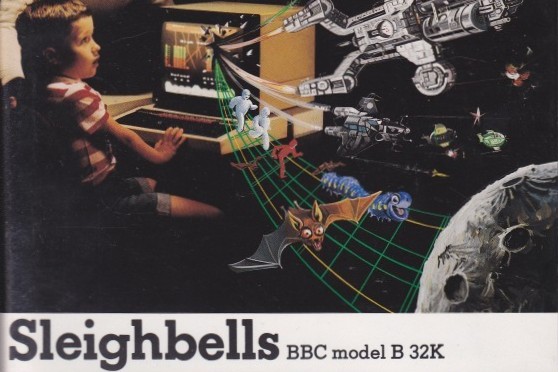
    Packaged in generic box art and featuring absolutely no sleigh bells, Sleighbells is a multi-screen game that probably has some arcade inspiration but I’d be very hard pushed to work out what it is. Narratively, Jack Frost, who always seems to have a problem with Santa, has stolen all the presents, and so as Santa’s assistant you have to venture into his secret cave and steal them all back. You do this across four screens:

    On the first screen, you have to get to the entrance while avoiding a gang of snowmen who make a beeline towards you. 

    On the second, you just have to run through the cave, avoiding the snowflakes that fall.

    On the third, you… do the same thing again, but there are snowmen popping out of the ground and there’s a bat flying about that will kill you literally the instant the level begins unless you move forward immediately. Fun!

    On the fourth, you’re supposed to catch the presents being pushed off ledges by… spiders(?) and move them to the left of the screen. The presents can squash you and that bloody bat is still there, but there’s absolutely no time pressure or anything so the first time I played this I just stood thinking I was “collecting” presents and wondering when the level was going to time out until I realised I had to move them one by one to the edge of the screen.

    And that’s it, although it loops if you haven’t gone completely doolally with all the excitement.

    This is, of course, rubbish, only remarkable because of how annoyingly difficult it seems at first (the snowmen mob you immediately, and that bat can fuck off) but once you get it it’s just a test of patience really. It does have a very festive title screen with a bleepy rendition of Jingle Bells, but that’s about as far as I’ll go.

    Festive vibes ranking: LOW

    Will I ever play it again? No!

    Final Thought: Something I would be remiss to mention is that the spirit of the BBC Micro does live on in the form of the Raspberry Pi, which does see lots of ordinary people learning how to hack away at a very open computer format, even it is usually just to get a media server running, or a emulation box. It might have been nice, as Ian Livingston pitched, if the device had led to a second Computer Literacy Project as the BBC Nano though.

    1. It’s Sleigh Bells on the title screen, but “Sleighbells” on the box. I guess I’ve decided house style is to say the box is correct. But this probably doesn’t come up much outside of slapdash home computer games. ↩︎
  • Santa (Artic Computing, 1983)

    Santa (Artic Computing, 1983)

    To view this content, you must be a member of Mathew’s Patreon at $1 or more
    Already a qualifying Patreon member? Refresh to access this content.
  • A Christmas Adventure (Chartscan Data, 1983)

    A Christmas Adventure (Chartscan Data, 1983)

    Developed/Published by: Chartscan Data, Inc.
    System: Apple II
    Released: 12/1983
    Completed: 11/12/2023
    Completion: Couldn’t get Rudolph to drink his bloody milk.

    Well, it’s been two years since I thought I’d “have a look at the earliest Christmas games” and I managed to play… one of them. And then last year I was sick for most of December so I didn’t really play anything other than tapping miserably at Marvel Snap. But I’m back, baby!

    First up, I owe almost all understanding of this game to Joe Pranevich over at The Adventurer’s Guild who has written an insanely detailed post on it which I highly recommend reading, but I’ll summarise some of the findings here.

    A Christmas Adventure is generally considered online to be the second Christmas-themed video game ever released commercially, following the somewhat bizarre Santa’s Sleigh Ride, but I’ve since discovered that there’s several ZX Spectrum games with a 1983 date (including one, potentially lost media, called A Christmas Adventure as well???) so there’s probably more out there for like… the Dragon 32 and shit. But let’s talk about this one anyway. What makes it more interesting than just potentially being the second Christmas-themed video game ever is that it isn’t just, as you might expect, a Christmas cash-in, but an attempt by a French Canadian fellow named Frank Winstan to make video games that acted as greeting cards. Mind how for a while personalised children’s books were all the rage, and you got this crappy book where a jpeg of your child’s face was awkwardly stuck on the main character? Like that basically, with the idea that they’d start with this Christmas “card” and then do… well probably Easter, and then branch out to like… “Happy 43rd Birthday: the adventure” or “Sorry Your Grandma is Dead: the adventure” I guess!

    Unfortunately (or not) due to time pressures they never quite managed to get the company off the ground, with this selling poorly its first Christmas, although Winstan would continue to work on it through 1986(!) updating and improving it. As far as I know, I’m playing a version from the same era ion Pranevich did, which seems to be a later version than the one you can watch on Youtube.

    Anyway. A Christmas Adventure is an early graphical text adventure; originally released in 1983, it would be contemporary with the very end of Sierra’s Hi-Res Adventure line before they’d go on to make the more sophisticated King’s Quest, and surprisingly, very few other examples, making this… sorta cutting edge?

    What does feel cutting edge actually is the opening cinematic, which you have to flip the disk to see, which includes an animation where you fly to Santa’s Ice Palace. Sierra’s Hi-Res Adventures have insanely terrible art (well, apart from Dark Crystal I’d say, which has a near stained-glass window approach) so getting something that generally looks like it’s had a bit of effort put in is rather nice.

    Telling that classic story, “Santa’s been kidnapped and only YOU can save him” after the intro you’re dropped in his house and have to wander about picking things up and using them to save him. I very quickly hit the issue that has stopped me bothering to play any of Sierra’s early output: the parser is terrible. Doing literally anything is a nightmare, and I will fully admit I had to use Pranevich’s article to walk me through the game, and he had to hex edit it just to understand how to solve it!

    It’s confusing, because this is a commercial concept based on greetings cards. Now, I imagine nowadays you can probably get “escape room” greeting cards where you have to like, solve a fucking cypher or whatever to see something that says “We’re getting divorced” (and if there isn’t, I should get on that) but in general, if you’re giving someone a gift like that you want them to… enjoy it? I really assumed that this would be very simple. You know, for kids. I mean you’re saving SANTA. Not Santana (ft. Rob Thomas) which would of course be for cool adults only.

    I suppose I’ve said it before, but maybe people in 1983 were made of sterner stuff; less likely to give up. I guess some puzzles in this are easy, like dressing up like Santa to fool his safe, or the disk that tells you the password right on it (Santa’s Jewish???) But then like… there’s a time machine. And there’s just so much wrestling with the parser to get anything done. Typing “HELP” gives you a list of words that the parser understands which is, 100%, a lie, because almost all the words don’t work.

    Ultimately, it’s the reason I couldn’t finish this. In his article, Pranevich was able to feed Rudolph, but despite having stuck the “was’bask+mlk” in the fireplace I could not feed him. I went through every possible thing I could imagine, really tried to get Martin Luther King out of that was’bask, but I’m starting to believe the archive.org version of this is just bugged. It is what it is, and I watched the ending on youtube (and for good measure used the HELP to see the message as well.)

    Feels a bit harsh to say this isn’t good despite the fact it it is, er… not good, just because it’s an interesting attempt at something that just seems to have come at the wrong time and with some rather wrong-headed ideas about how challenging it has to be. Also: it didn’t make me feel Christmassy at all!

    Festive vibes ranking: Despite the setting… LOW

    Will I ever play it again? I have a save. If anyone can tell me what to type to get Rudolph to eat I’m making that bastard eat.

    Final Thought: It’s worth noting that you can really feel the developers–at least Frank Winstan?–cared about this project because it’s full of little touches. I love that Santa has a poster of Bob and Doug McKenzie’s backdrop up (as Canadian a reference as you’re going to get) and there’s non-sequiturs like Pac-Man showing up for a hot minute.

  • M.U.L.E. (Bunten Berry, 1983)

    M.U.L.E. (Bunten Berry, 1983)

    Developed/Published by: Dani Bunten Berry / EA
    Released: 11/1983
    Completed:
    24/06/2021
    Completion:
    Beat Tournament mode against 3 AI with a colony score of 110,000+
    Trophies / Achievements: n/a

    MULE is an interesting one. I was trying to think what the cinema equivalent is, as a sort of easy metaphor: a classic that was lauded (if never particularly imitated) by a generation of filmmakers that goes almost completely unwatched these days. It’s not one of the obvious ones (you know, Super Mario Bros. as Birth of a Nation, or something); it’s too sophisticated to be something super early (Space Invaders as Journey to the Moon) and so I just can’t place it. The Red Shoes, perhaps?

    The thing is though–and I suppose it’s the reason I’m trying to draw the metaphor–is that if you want to watch The Red Shoes and see what the likes of Scorcese have raved about, you can do so easily–it’s streamable on about nine different services, free with subscription or even ad-supported; you can buy it on a Criterion blu-ray and get a boat load of special features to give you context. Nothing is holding you back.

    Here’s how you can play MULE: you can pay $8 to Good Old Games to play the trash PC port that is totally unrepresentative (it’s maybe also available on Origin, but I haven’t looked.)

    Ok, so you don’t want to do that (and it’s not Good Old Games’ fault: they near-exclusively sell PC games). So here’s how you play MULE “as intended”: You have to download an Atari 800 emulator or understand how to make something like Retroarch make that happen. Then you have to find a ROM (watch out! You might download a pirate one that crashes if you catch the wumpus!). Then you have to find the BIOS files that will let the emulator run the Atari 800. Oh and don’t forget that the Atari 800 emulator requires a bit of fiddling to make that work. And because you want to see the game as intended, you’ve either now got to make this run on that CRT you’ve got lying around for this sort of thing or run it through a shader, preferably with a nice border so it looks like you’re running it on an old TV.

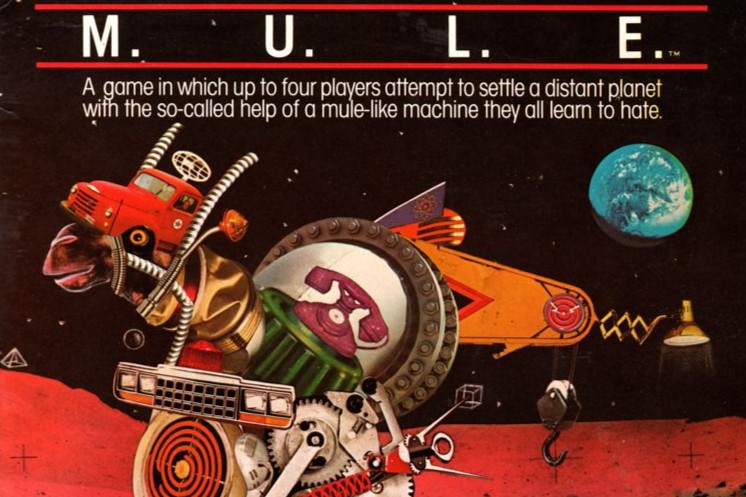
    Oh, and for context, you’re going to want to look up the (beautiful) box and manual online.

    The alternative, is, of course, to buy an Atari 800, monitor, a copy of the game (good luck finding it for less than $200) and four joysticks.

    This is, clearly, absurd. Now don’t get me wrong; there are lost films and inaccessible films. But MULE is out there, and in the history of games it’s at least as important as The Red Shoes is to cinema. But you have to be extremely dedicated to play it–and worse, if you don’t need to be (for example, you pass an Atari 800 in a “VIDEOGAMES!!!” exhibition at a museum) it will be completely impossible to grasp.

    So anyway, that sucks, because if you’re a student of games and their history you should play MULE, and not just because it’s honestly still pretty fun. Because it’s passed into this position that people only talk of it from the second or third hand–often to pay tribute to the pioneering Dani Bunten Berry–and I actually feel a bit sad about that. We pay tribute to those who came before us by playing their work, not just talking about it.

    [“OK, now start the criticising”–Ed.]

    How dare you… ahhh you got me. I think MULE is super cool but here’s the thing that happens after you put in all that work: you go “mannnn this is olddddd” because MULE is old, and “80s personal computer” harsh. It’s at its heart almost a board game, but it’s slathered in early “we haven’t quite worked all this out” design decisions that sorta made sense at the time but also extremely don’t now.

    It’s played like this: you and up to three other players (though it’s always played with four) are settling a planet; each round you have to select a plot of land (from plains, mountains or river) and then select a mule, equip it to either mine ore, collect energy or farm food, which it can do on any plot (well, you can’t mine on river tiles) but gain the most benefit from doing so on the equivalent tile. After everyone has done so, a random event happens (a solar storm makes more energy production, for example) each commodity is consumed by your community and the surplus is traded: either to or from other players or to or from the town store. And then the next round happens (oh, and sometimes you can buy plots of land at auction, not just take them when given.)

    It’s actually pretty graspable, but the quirk is the law of supply and demand. With particular lands (and land placement) you can create massive surpluses of certain goods, and you can also choose to ignore some goods even though your community needs them. “I’ll make so much money selling this ore” you think, “that I’ll be able to buy as much food as I need.”

    Trading happens in a format that must have inspired the negotiations in Theme Park (“Ah yes, I know exactly the mini-game”–every reader, who is as decrepit as me) where you walk your characters down or up the screen to meet at a value, with the quirk that if the store doesn’t have any of a good to sell you the sellers can walk back infinitely (well, within the set time limit) to bleed you dry. (And the computers will do this…) BUT–if they do this, they’re in danger of the colony getting a bad score at the end of the game! So it’s all about the balance of winning (individually) without losing (as a collective). Man sounds like those clowns in congress should play some MULE, am I right???

    So far so good, right? The problem is it’s the early 80s, so all of this is done with a one-button stick where you have to control your character and make them walk into the mule pen and then walk out with the mule and then walk into the outfitter and then walk to your plot and then the timer runs out because you didn’t make enough food, or because moving your character is janky as hell. And selecting your plot of land? Oh that’s a reaction test as a cursor moves along the screen (faster on the higher difficulties) meaning the PC is gonna screw you out of half your lands (and mis-timing is going to screw you out of the other half.) And because there’s not that much space on the screen, actually fully understanding supply and demand in context… isn’t going to totally happen. You need to remember how much of a good you need to buy to not be in shortage. How the shop price affects things and changes is… obscure.

    Which is not even to raise the nadir of MULE: random “punishment” events. Yep, this was designed well before balancing was really a thing, and they had the best intentions at heart, but “lift up the low boats” wasn’t a thing– “smash the high ones with a tsunami” was. It’s a bummer because it doesn’t really work. It’s super clever to make the winning players play first (so it’s easier for the worse off to strategise) but some players can get into such a commanding position that losing some money here or there isn’t that bad. And instead, things tend to happen like you scrimping and saving, finally getting your engine up and running, lots of ore coming in… and a pirate ship shows up, takes all your ore on a turn when the players ahead of you all switched to energy and food, and now you’re stuck with nothing to sell and no way to afford the energy or food you need to keep your plots going. It is the dogshit worst.

    That said, while MULE has the capability to cause (and must have caused) Monopoly-esque meltdowns, the game is still dang fun if you can get into the mindset. The AI is hilariously vindictive–I love that it will screw you on land auctions if you try and force the price up to screw them (it’s all about timing when to walk backwards…) and that they’ll be extremely selective as to when to buy from you, even if it hurts them (I’d swear it knows it doesn’t need food towards the end of the game…) and if you save-scum away only the bullshit punishments or mis-clicks (be generous; it’s 2021) the core here is so dang solid–and it only really makes sense as a video game, because I’ll be fucked if I’m calculating the new cost of mules based on the previous trading period using a table in a board game manual or something.

    Is it a classic I’ll return to again and again? No, not really. Is it something that any student of video games should play once, twice, three times at least? Of course, and if there’s anything you take from this it’s criminal that they probably won’t.

    Will I ever play it again? I am desperate to play this on tournament mode with three other experienced (but not too experienced) players IRL. No joke desperate. I think there some of my issues (the misclicks; the punishments) stop becoming as massive an issue when you’re playing with more than two people…

    Final Thought: Shout out to TreyM for their classic CRT overlays! This kind of thing really doesn’t feel right without them–and they’ll continue to help me experience things “in context” as much as I can when I get to the likes of Rescue on Fractalus…