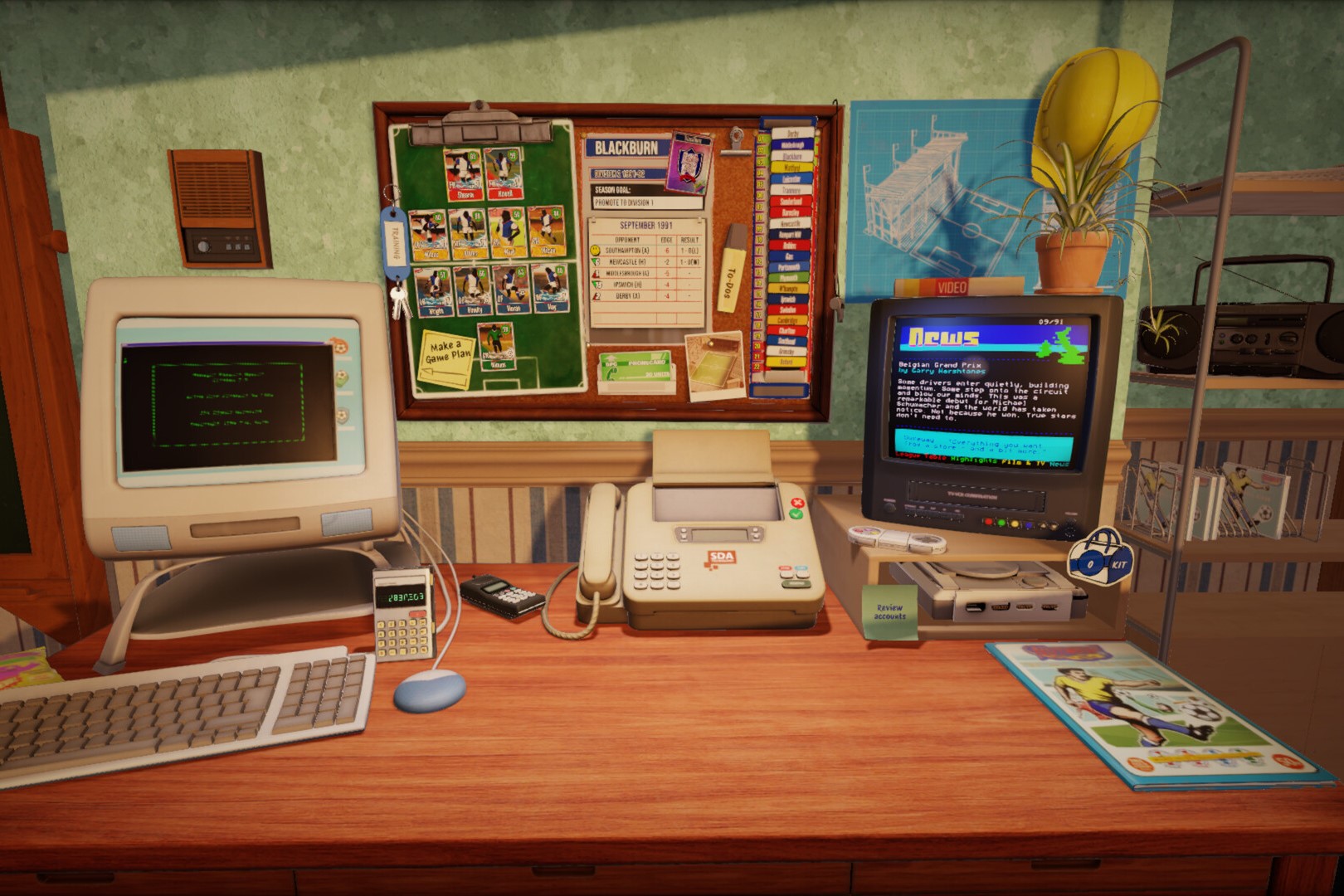
I’ve been playing Nutmeg! Sumo Digital’s “Nostalgic Deckbuilding Football Manager” during the World Cup and enjoying it a great deal, but I found it difficult to get into originally due to a tutorial I didn’t quite get and the game’s extreme (if charming) skeuomorphic UI. The game actually has quite a simple rhythm to it and the actual deckbuilder—once you understand what it’s doing—is fun rather than frustratingly random, so I thought rather than just post up a review of it I could immediately recommend it and explain how to play it rather than have you waste half a season not sure what you’re doing. Of course, working that out might be part of the fun for you—I might be making it too easy for you here—but this is a solid foundation to play the game from, I think.

The Management Bit
So, the thing about Nutmeg! is that even though it’s a deckbuilder, it’s not really what you’re going to spend most of your time doing. You will, ultimately, be doing a lot of managing a football team, trying to manage costs, buy and train players, and give yourself the best chance of winning as many games as possible as you only play one card game out of five matches.
(If you like you can play every match by choosing “marathon mode” but one of the most important things you need to understand is that you just aren’t going to win every match, and especially in the early game while you’re slopping about in the fourth division that’s going to be quite deflating. You want to choose the games where you think playing will give you the edge.)
The game is played on a month-to-month basis. Each month you’ll play five games–possibly a sixth if the Egg Cup is on–and you can see your “edge” in each match, so you can work out which games you can delegate because you’ll probably win, or delegate because it’s a “scheduled loss” or play to win.
At the start of each and every month, you’ve got a lot of housekeeping to do. First, check your “To-Do” list (the highlighter on the board.)
- This has a few things you need to do in order to get a free booster pack of cards. You want this booster pack, especially if you’re trying to drag a crap team up. The things it asks are pretty simple, and if you follow this guide you’ll know how to do them. Some, like winning games, are sadly a bit of luck unless you want to save-scum, but the main one you have to watch out for are the media interview requirements: you’re more likely to get them when you win games by a lot of goals, so you might want to broadcast some games you’re favoured in.

Now you want to go straight to the magazine on the table.
- You want to check if you have the best staff possible. The game has three kinds of staff: coaches, support and office.
- All staff can provide “recipes” which are necessary for the deckbuilding portion of the game. In my opinion this is a major priority: you want as many of the right recipes as possible. You may wish to keep a slightly weaker staff member for the recipe(s) they offer.
- Coaches train players and ensure you have the right kind of cards for the deckbuilding game: defence, control, attack, goalkeeping, and stamina.
- Support includes assistant coaches, which you want a lot of as soon as you have any players who have skills, as they are the only way to train those skills. There are scouts, who find players and give you their information. Other support include psychologists and nutritionists and things like that, who help with morale, provide half-time boosts and may need to be unlocked by building facilities.
- Office staff are things like accountants and recruiters who help with your budget or help find better coaches and other staff. A good recruiter seems very worth the money.
- There’s no downside to firing staff and hiring new staff on a month-to-month basis, so just always have the best staff you can!
- You want to check the transfer market. Use your scout to scope out any player that catches your eye that you can afford (you can’t go into debt buying players) and hope they have some skills. You want players with skills!
- When buying a player you need to make an offer, with a percentage chance of it succeeding. You only get one chance, so work out how much you want them. You may wish to make promise like playing in the first eleven or training to snag them–and when you’re poor, that will be necessary. But it becomes a ball ache later when the player simply isn’t good enough any more because you’ve gone up a division–you’re at the mercy of the market if you have to shift a player and they can hang around and cause morale issues.
- Don’t forget to list players for sale that you don’t need, too. Obviously, just pick the ones with the lowest numbers, but be aware that some seemingly crap players have high potential, so you might want to hold on to certain younger players and hope they train up fast.
- If you need to, check the front page of the magazine to see if you’ve still got a sponsor or not. If you don’t, hop on the phone, call the commercial director, and take a sponsor.
- Sponsors largely have a negative effect on player, fan and board morale. I’m not entirely sure why this is, but it doesn’t particularly matter because you’re wanting to build that up by playing well, and you need money. Football is a money game even at the lowest tier.
- Speaking of: go to the computer and check your merchandise. You want to try and match your merch to the season/how well things are going. To be honest, this doesn’t seem like it matters a ton, but if it’s winter, you want to be selling wooly hats. Summer, caps. As soon as you can, buy the merch facility because it allows you to sell four pieces of merch, meaning you can largely set this and forget it.
Phew! Now you have to do something every week:
- Check your skills training. At first, this is going to be fine, because you’re going to have like one or two skill training slots and maybe a couple of players with skills. But you’ll end up with six slots and entire team of skilled players. Skills degrade, so you will have to juggle players around these slots constantly. Is this boring and annoying? Yes. But it’s also something you’ll want to do, because skills give you “crits” and the percentages can be high (like 50%) giving you situations where players automatically succeed passes and even at scoring goals.
Meanwhile, play or delegate the game each week.
- When delegating, use your judgement on what positioning to use but be prepared for the percentages to go against you no matter what you choose. Injuries are really common in Nutmeg! so you’ll probably constantly have to shuffle players around–don’t think you can sell all your subs to save money. You’ll want a minimum of a couple of players spare for every position–this can be an issue definitely with forwards, because the game doesn’t have any formations like 5-4-1 so if you’re down to one forward you’re stuck playing a midfielder out of position.

Before the last game of the month, go back to the computer and check attendance. If you’re filling your stadium, go to the blueprints and buy an upgrade (if you can afford it) or plan to do so as soon as you can. It’ll get built immediately at the start of the following month.
You can buy facilities at any point as soon as you can afford them, because they get built instantly. You want the ones that make money or allow you to hire new staff. Past a certain point, it makes sense to leave a facility space open for sponsor facilities, which are free and make you the big bucks.

Playing Games
Before you choose to broadcast any match, go to training and make sure you’re chosen a coach to “focus”. One of Nutmeg!’s biggest issues it that you can’t see the hand of cards you hold already1 so you’ll have to remember if you are–for example–completely lacking any goalkeeping cards and so you want to focus on the coach that provides them. Once you’ve done that, choose to broadcast the match.

- Before you actually play the game, you will open a “booster pack” of cards that you can add to your hand. But what you really want to do is to have a bunch of recipes–thanks to your staff, or players who also can provide them–allowing you to combine cards into much more powerful ones. You don’t want a basic Sidewinder card (+30% to saving a goal.) You want to merge that with another Sidewinder to get the “Penalty King” card, giving you +60%.
- You always want to come into matches with some goalkeeping cards. You can never draw them from the tactics deck.
- Frankly, I don’t know if formation really makes any difference in this game–in every delegated match 4-4-2 seemed to be the best option, so I never changed it. The classics are classic for a reason, I guess.
- However, your positioning–to either drop back, push up or hold shape–absolutely matters, and you can change this between every game event if you wish. This is important because during a game you will be aware of what cards you have in your hand: if you have no attacking cards, but lots of defensive cards, you can “push up” to try and draw more attacking cards from the tactical deck, which are “free” cards you draw if your hand isn’t full. If you just want to try and park the bus after a few goals, “drop back.”
- IMPORTANT: before playing games, you can look at your opponents players, and if any of them take your fancy, “headhunt” them using a scout action and have them show up for transfer the next month. This is an important way of growing your squad with better players–don’t forget to do it!

The way games are played is a match is boiled down to a series of runs. I’ll be honest–I don’t know quite what the system is that decides when in the game and how an event is chosen during runs–but if you watch the pitch map that gets drawn on the side of the screen, it might be fairly complex (or all smoke and mirrors.) In each run, you’re either defending or attacking, and a series of events are played until the run ends via an event that ends it (a goal, or a tackle, for example.)
- Every time you can play a card, you are trying to affect the percentages of the cards on screen in your favour. Generally, there are three cards available per event during a run: one that benefits your opponent, one that’s neutral(-ish) and one that benefits you. You want to increase the percentage of “goal” over “miss” or “save” (to give the most obvious example) by playing the best attack card (so a Goal Rush card, that gives you +30%, is what you want to play.)
- You can only play the kind of cards that match the event. So if you’re all out of defensive cards, you are at the mercy of the quality of your defenders. This can go wrong fast.
- The most important thing to understand is that Nutmeg! is sort of… card-based football X-COM. You are going to get screwed by the percentages, and it’s going to feel even more unfair if you’ve just spent a bunch of cards to get to goal and your opponent crits and automatically saves your shot. The entire game is about putting yourself in the position to win–not guaranteeing your win. It is amazingly accurate to football in that way.
- If you score a goal, you get momentum, which means you get cards back in your hand–so there is a benefit to spending your expensive cards chasing the win.
The most important thing about a match, however, is that you keep the cards you don’t play for future games (apart from any free cards from the tactical deck you draw during the game.) This means that you have incentive to burn tactical deck cards and also to play conservatively when you can. Momentum is important here. If you’ve scored a goal and are winning, you might not want to burn new cards to score another–but you’ll lose the cards you’ve played even if they go back to your hand (where amusingly they look tarnished) so you can play them again. Similarly, if you’ve scored a bunch of goals, you might want to hold off on spending expensive defensive cards unless you’re facing an equaliser.
After a game, sometimes you’ll get called by the press to comment. This can’t go wrong, so just praise whichever stakeholder needs the boost unless your to-do list requires you praise someone specific.
Anyway, that’s basically Nutmeg! Have fun!
- If you can see this somewhere I couldn’t find it, which I think is on the game, not me. ↩︎



 Unlock with Patreon