All of Powell and Pressburger’s films are, in my opinion, quite strange to modern eyes (even compared to their contemporaries) with unusual tones and pacing, but for me this is absolutely the strangest yet (and that’s including A Matter Of Life And Death, which is completely bonkers.)
On the surface, our Colonel Blimp, Clive Wynne-Candy, reads as hero, played, as he is, by the iconically charming Roger Livesey. But The Life And Death of Colonel Blimp is also a harsh criticism of him–and the actions of the British Empire–when read more deeply and with historical context. It’s asking a lot of the audience to come to the film with that, and what I find most strange about The Life And Death of Colonel Blimp is how much it tries to have its cake and eat it: Candy is a fool, but he is still portrayed as a good person, the protagonist you root for, and the ultimate feeling of the film is one of apologia. I’m not sure that’s fair; or rather, I’m not sure it’s fair that audiences ever walked out feeling sorry for him.
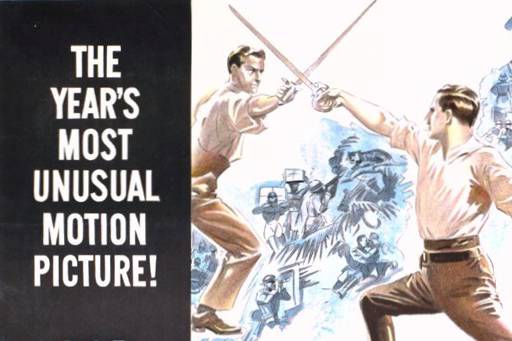
Based on a newspaper cartoon that satirised the reactionary opinions of the British establishment, if you understand background such as the British behaviour in the Second Boer War(!) Candy comes across as not so much foolish as in outright denial even as a young man–he ends up in a duel with a German officer over dastardly Hun propaganda about the existence of concentration camps, which, of course, there were.
He’s also deeply emotionally stunted, and this is shown by him being haunted by the woman he loved and lost like he’s Francesco Dellamorte in Cemetery Man, as she re-appears as every new woman in his life. And each time he struggles, his emotional outlet is murdering exotic animals as some sort of a balm (I’m sorry but if you murder an elephant you’re a grade-A cunt.) I’m not quite able to fully translate the metaphor to the British Empire’s stymied ambitions across the early twentieth century, but it probably works.
If you see Candy as such, the true hero of the film is Candy’s pal, German officer Theo Kretschmar-Schuldorff, played by the incredible Anton Walbrook. This must have been an intense role for Walbrook, who himself escaped from the Nazis, and as Kretschmar-Schuldorff he shows the kind of insight–borne from loss–that Candy never seems to attain. The sequence in which he pleads his case as a refugee is undoubtedly one of the greatest in all of cinema, and I understand why his sympathetic portrayal was considered so controversial in the era. It’s too good. The British public might have had their minds opened and the establishment needed to make sure they’d stay snapped shut.
You can also read satire, I think, when Kretschmar-Schuldorff is sat with Candy and the British empire’s regional dictators, all stuffy old white men who swear blind they’ll do the best for Germany while they extract what they can without a care from their own fiefdoms (while, of course, leaving Germany to its ruin.) There’s something very prescient, too, about the way Candy says “I wasn’t in a foreign country, I was in Jamaica”–it reads as patently absurd and paternalistic, even though Jamaica wouldn’t achieve independence until 1962.
This does make The Life And Death Of Colonel Blimp sound like a laser-focused, forward-thinking satire, but the film takes a leisurely pace across its nearly three hours, and what’s there is a lot more subtle in context than I make it sound. The moments I have described are just part of a film that otherwise puts a lot of effort into impressing on us that Candy is, in general, a stand-up guy who believes in, and tries to do, what’s right. And the film pushes towards the apparent conclusion that he (and therefore, Britain) are only flawed in so much as they have slowly–stuck in their ways–fallen out of doing what needs to be done. That they’re trying to be too honourable, when they should instead [checks notes] fight the Nazis like… the Nazis would?
This is, in my opinion, a strange conclusion for a film that shows such incredible empathy and understanding via Kretschmar-Schuldorff, and there’s a sour taste to it in the light of the film’s own satire–and ultimately what we know now about the Allies’ conduct during the war (the bombing of Dresden would happen just a couple of years later.)
The thing is, I understand the argument that can be made against what I’ve just written–films are allowed to be complex; even contradictory–people absolutely are (I take some pleasure that The Life And Death of Colonel Blimp’s Criterion essay seems just as confused about the film as I am.) We don’t, and can’t, live only in a world of basic morality tales, of perfect good via evil, and it is a bit sad that our major cinema has so devolved to that. And The Life And Death Of Colonel Blimp is a beautiful film, full of every touch we know Powell and Pressburger for, and a performance from Walbrook in particular so good that it makes the Oscars look like a joke because he never received one.
Indeed, I think it’s telling that Churchill–an odious racist who knew everything the British were willing to do–reacted in such fury to this film. He could see what lay beneath the surface. But even with that, I can’t quite square the movie’s apparent understanding that the British Empire was not honourable in the least with the implication that it needed to plunge farther into barbarism. If I’m charitable, maybe it was simply a call for it to stop lying to itself about what it was.
Follow Mathew on Letterboxd.